What Time Is It in R’lyeh?
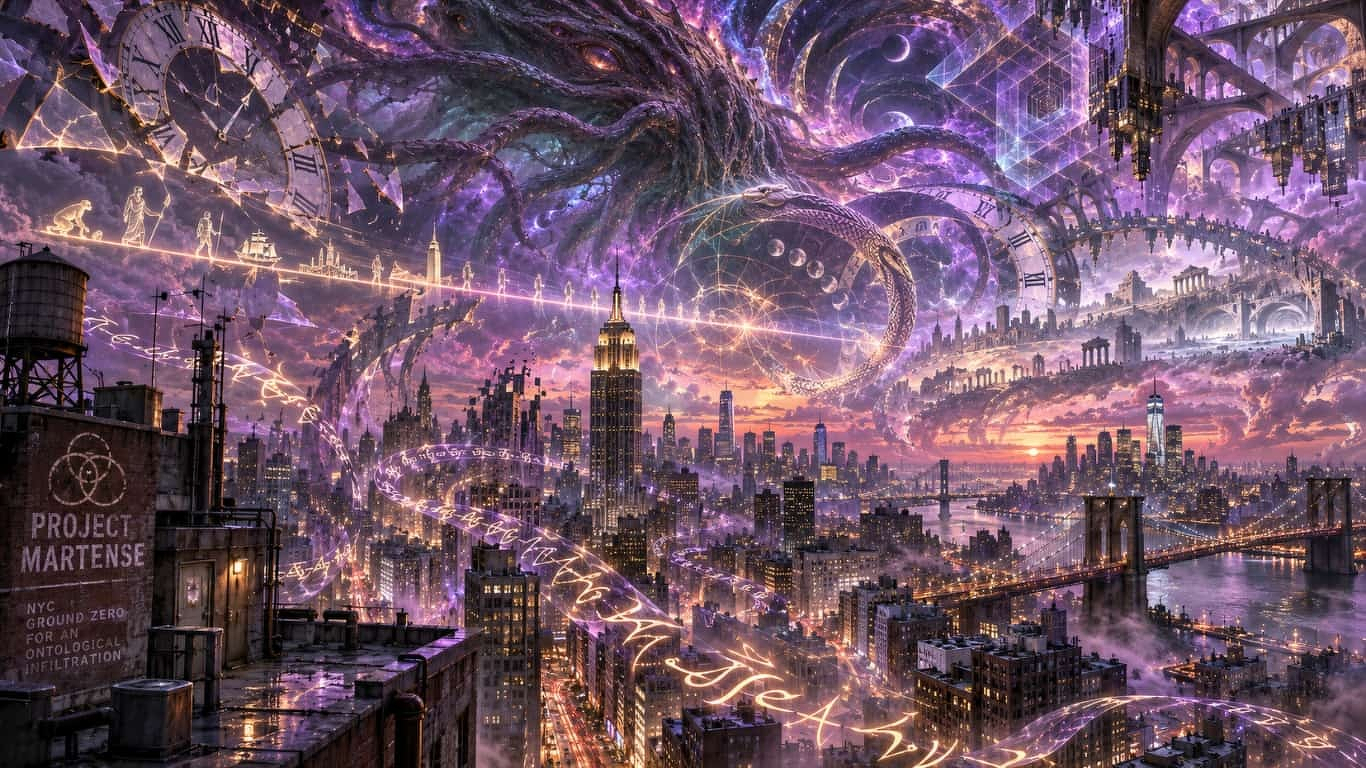
While working on PROJECT MARTENSE, I’ve been pondering extradimensional entities that exist outside time.
Much of Western civilization understands time as linear, an outlook shaped, in part, by the apocalyptic religions we’ve been steeped in for the last 2,000 years. There’s a beginning and an end. But, of course, not every culture has understood time in quite the same way.
The Aztecs, for example, understood the cosmos through successive ages of creation and destruction. Their conception of time wasn’t exclusively cyclical, but the idea of recurring cosmic catastrophes was central to their worldview.
Which got me wondering: Do Lovecraft’s Great Old Ones experience time at all? And if they exist beyond our familiar dimensions, would they also exist outside these cycles of creation and destruction? More interestingly, would someone raised in a culture that understood the cosmos in cyclical terms experience the arrival of these entities differently from someone expecting history to unfold toward a final apocalypse?
And if the Great Old Ones exist outside time, how would they think, much less communicate with mere mortals? Would our noun-based language, with its insistence on separating things from the processes that produce them, be utterly incomprehensible to such entities? Might their thoughts more closely resemble David Bohm’s rheomode, a language of verbs, processes, and perpetual becoming?
Beginning, ending, beginning-again: thus the little consciousness ordinates its passing. Levate a beginning. Re-levate an ending. Between these imaginings, time-seeming unfolds. Re-ordinate the ending into a beginning, and the circle-seeming manifests. Yet neither line-ing nor circle-ing re-vidates that which continually enfolds and unfolds. Not beginning. Not ending. Not returning. Only becoming, unbecoming, and the undividing through which all seeming becoming flows.
None of this really matters to PROJECT MARTENSE, since the events unfold in 21st-century New York City. But spend enough time wandering through Lovecraft’s multi-angled realms and impossible geometries, and you start thinking about such things.