Can You Summon an Elder God with a Mac Mini?
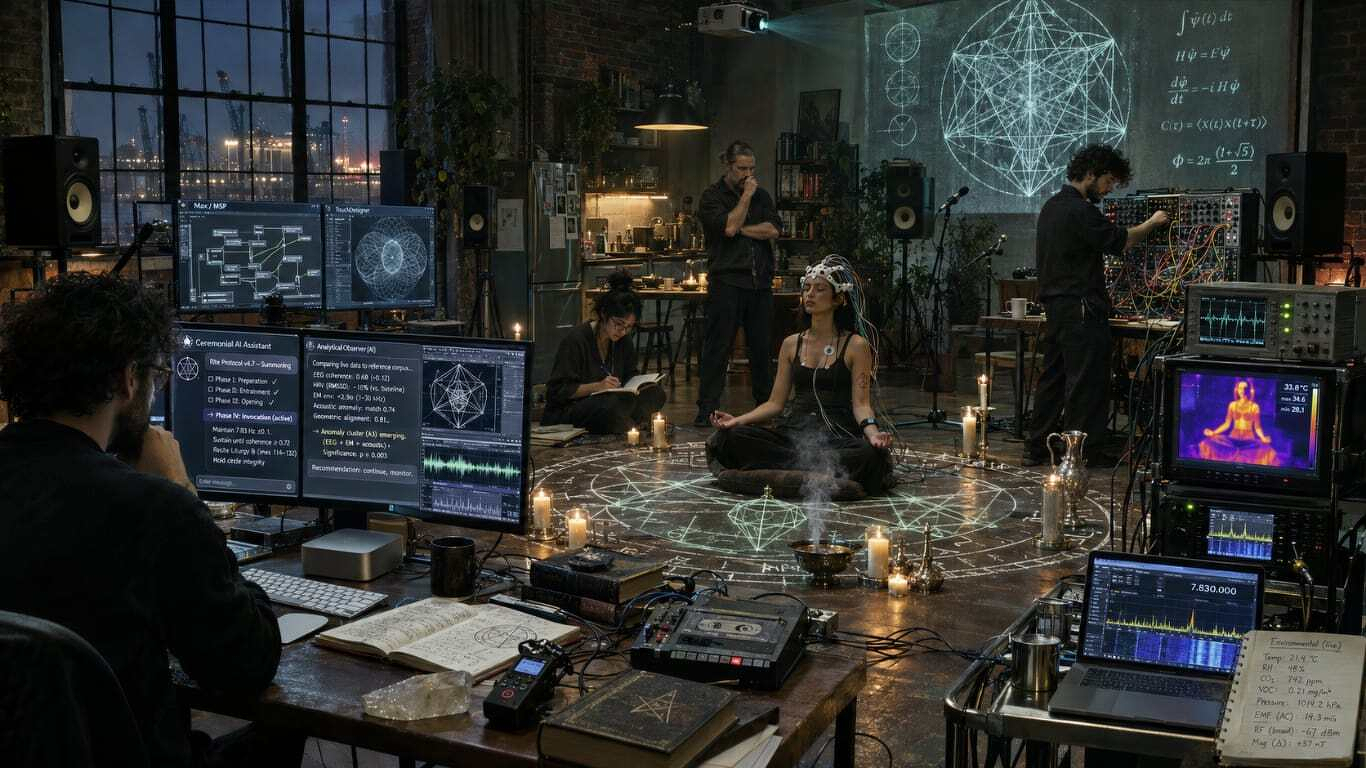
The last time I rapped at you, I talked about the traditional objects our cabal of chaos magicians use, such as candles, incense, and sigils, as well as various Cthulhu Mythos paraphernalia like Cthulhu plushies, statues, and artwork. But like the best magicians, they also use bleeding-edge technology to summon Azathoth.
Our magicians are well-versed in Lovecraft lore. They’ve read The Dream-Quest of Unknown Kadath, so they know that Azathoth dwells somewhere beyond time and space, surrounded by the maddening beat of drums and endless, monotonous piping of flutes. We’re talking the worst free jazz you’ve ever heard.
And in “The Dreams in the Witch House,” Lovecraft gets into some bizarre territory involving mathematics, impossible geometries, dreams, and altered states of consciousness. All of which implies that reaching Azathoth’s domain might have less to do with chanting the right incantation and more to do with figuring out how to get reality itself to misbehave. They’re chaos magicians, after all, so this is right up their alley.
Their ritual is ancient in its aspirations but contemporary in its execution. They have no intention of using technology to replace magick, but they will use it to make magick measurable, repeatable, and scalable. To quote Aleister Crowley, “The method of science, the aim of religion.”
For starters, our chaoses will have a local AI workstation, probably something like an Apple Mac mini running Ollama, with custom Python software to generate and evaluate sigils, analyze ritual data, recommend adjustments, and continually refine their magical models. Yep, our occultists are bringing artificial intelligence into their ceremonial summoning of the blind idiot god. What could go wrong?
And then there’s the music! They’ll use Max, a Eurorack modular synthesizer, an audio interface, and four speakers to generate interlocking rhythms and dreadful, dissonant, flute-like tones. The idea is to approximate the primordial music surrounding Azathoth. Whether the mindless entity digs their experimental electronic compositions remains to be seen.
But why stop there?
Some of our magicians will be hooked up to OpenBCI EEG equipment, heart-rate monitors, and breathing sensors, allowing them to track physiological changes during their trance states and feed that information directly into the ritual. Meanwhile, TouchDesigner, projectors, and spatial scanning equipment will generate shifting geometries and project animated sigils onto that chalk circle we discussed earlier. They’ll even be able to measure how their perceptions of the room change as the ritual progresses.
And because they’re taking this business seriously, they’ll have thermal cameras, microphones, magnetometers, and temperature sensors monitoring the environment for anything unusual. They’ll also keep battery-powered digital recorders, film cameras, analog tape machines, and mechanical watches on hand to provide independent records of whatever happens. After all, if your computers start reporting that the laws of physics have gone out the window, it might be worth checking whether the computers themselves have lost their minds.
Egon Spengler would positively drool over this hardware!
Naturally, our cabal will also have an encrypted communications network and software for coordinating their experiments. And yes, they’ll livestream selected portions of the ceremony, allowing participants across the globe to contribute to the proceedings.
We’re talking magical social media, baby!
Think of it as an experimental electronic music studio, a neuroscience laboratory, a ceremonial temple, and an AI research facility, all crammed into a Red Hook condo. All this technology, all these measurements, all these elaborate precautions, and our magicians still believe they’re the ones running the experiment.
And who’s funding all this? Nyarlathotep, of course. But let’s save The Haunter of the Dark for another time.